
In the age of generative AI, code has transformed from a laboriously hand-crafted asset into an abundant commodity. With a brief prompt, an AI agent can generate hundreds of lines of code in seconds. Yet, enterprise leaders are discovering a frustrating truth: generating code quickly is not the same as building the right software.
When organizations rely on unguided natural language prompts—commonly called “vibe coding”—they run straight into hallucinated architecture, security vulnerabilities, and subtle misunderstandings that multiply technical debt.
To build complex, production-ready software with AI, we must shift our primary focus. In Specification-Driven Development (SDD), code is no longer the principal source of truth. The specification becomes the authoritative anchor.
Without a rigorous specification, AI agents simply guess. With one, they become hyper-efficient execution engines.
Why the Specification is Essential in the Era of AI
In traditional software delivery, specifications were often temporary documents or scattered Jira tickets that quickly drifted away from the actual codebase. In an AI-native workflow, the specification takes on a fundamental new role:
- Framing Intent Before Syntax: AI models do not possess implicit knowledge about your business goals, security policies, or user personas. A structured specification externalizes this intent, ensuring the AI is bounded by clear business logic before it writes a single line of code.
- Eliminating “Interpretation Drift”: When requirements are vague, human engineers make independent assumptions. AI agents do the same, often choosing statistically plausible patterns that violate domain rules. A precise spec removes ambiguity upfront.
- Moving Review “Up the Stack”: Reviewing thousands of lines of AI-generated code line-by-line is exhausting and ineffective. SDD allows domain experts and human reviewers to validate the high-level specification before generation, making quality control proactive rather than reactive.
The 5 Stages of Intelligenic’s Specification-Driven Development
At Intelligenic, we have operationalized SDD into a structured, five-stage lifecycle. Designed to keep human oversight at the center while unlocking the speed of AI automation, every product moves through these distinct phases:
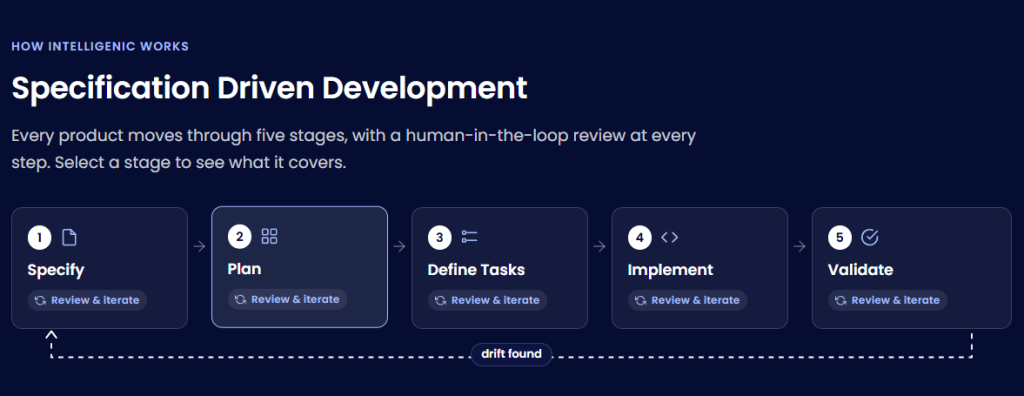
1. Specify
- What Happens: Capture the problem statement and the users affected, define explicit goals and non-goals, draft acceptance criteria, and flag unclear questions for review.
- Why It Matters: A clear specification prevents wasted implementation work and provides reviewers with a shared basis for judging whether a solution is correct.
2. Plan
- What Happens: Choose architecture decisions and affected modules, define the data model and API contracts, identify migrations and security concerns, and set the test strategy.
- Why It Matters: Planning surfaces risks and technical tradeoffs before code is written, when architectural changes are easiest and cheapest to make.
3. Define Tasks
- What Happens: Split work into small, ordered tasks and stories, sequence them by dependency, list files likely to change, and set validation criteria alongside human review checkpoints per story.
- Why It Matters: Small, ordered steps keep each change reviewable and allow architectural drift to be caught early rather than at the end of a sprint.
4. Implement
- What Happens: Develop code one story and task at a time, resetting context between them, applying the constraints set during planning, and updating the plan if reality differs.
- Why It Matters: Isolating stories and tasks keeps generated code traceable to a single, reviewed intent rather than a sprawling, unverifiable change.
5. Validate
- What Happens: Run automated tests, linting, and type checks; re-verify acceptance criteria; conduct a manual review; and produce a spec-to-code diff.
- Why It Matters: Validation is where any drift between the spec and implementation is exposed. If drift is found, it acts as the trigger to loop back to Specify and refine the contract.
The Power of the Loop: Catching Drift Early
Notice the dashed loop in the Intelligenic model: Drift Found.
In traditional “vibe coding,” discovering that a feature doesn’t meet business needs forces developers into endless prompt tweaking or manual debugging. In Intelligenic’s SDD framework, validation explicitly measures the diff between the specification and the implementation. If the code strays from intent, the team loops back to refine the specification—not the raw prompt.
By grounding AIexecution in governed, machine-readable specifications, enterprise teams stop fighting technical debt and start converting development velocity into real business growth. When you control the specification, you command the AI.